
The ongoing Iran–U.S. geopolitical conflict has entered its second week, creating tension across global financial markets. Historically, wars and geopolitical shocks push investors toward safe-haven assets like gold and silver, while energy markets experience sharp volatility.
Yet something unusual is happening.
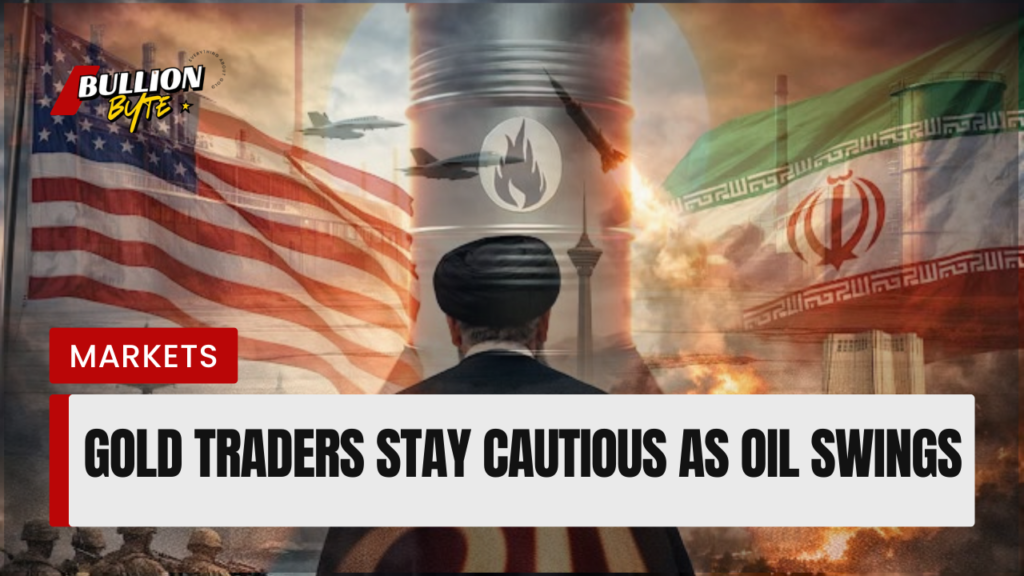
Despite rising geopolitical tension in the Middle East — a region responsible for a major share of global oil supply — gold and silver prices have remained relatively stable instead of surging dramatically.
This raises an important question:
Why haven’t precious metals rallied strongly during a war that could disrupt global energy supply?
To understand this puzzle, we need to examine several critical factors shaping global markets.
⚔️ The Strategic Importance of the Strait of Hormuz
One of the most sensitive geopolitical points in the world is the Strait of Hormuz, located between Iran and Oman.
📊 Key Facts:
🌍 Around 20% of global oil supply passes through the Strait of Hormuz daily.
🛢️ Approximately 20–21 million barrels of oil per day move through this corridor.
🚢 It is considered the world’s most important oil transit chokepoint.
If Iran disrupts oil shipments through this route, global energy markets could experience a massive supply shock.
So far:
Oil prices briefly surged above $100 per barrel
Then stabilized near $90–$95 range
Markets appear to be pricing in a limited or contained conflict, at least for now.
🪙 The Gold Market Puzzle
Historically, gold reacts strongly to war and geopolitical crises.
📈 Examples from history:
| Conflicts | Gold Reaction |
|---|---|
| Iranian Revolution ( 1979 ) | Gold surged ~240% within a year |
| Gulf War ( 1990 ) | Strong rally in safe-heaven assets |
| Russia-Ukraine War ( 2022 ) | Gold Spiked rapidly |
However, during the current conflict ; Gold initially rose about $200 (~2.6%). Then moved sideways
Currently fluctuating in a tight trading range
This muted reaction is puzzling for many analysts.
🏦 Relevant Reasons Gold Has Not Exploded Higher
Several explanations are currently being debated across financial markets.
1️⃣ Strong U.S. Dollar
Gold is priced in dollars.
💵 When the U.S. dollar strengthens, gold often struggles to rally because it becomes more expensive for international buyers.
2️⃣ Interest Rate Expectations
Higher interest rates reduce the appeal of non-yielding assets like gold.
If markets believe the Federal Reserve will keep interest rates elevated, gold demand may weaken in the short term.
3️⃣ Institutional Activity in Gold ETFs
Another important factor is activity in Gold Exchange Traded Funds (ETFs).
The largest gold ETF — SPDR Gold Trust (GLD) — recently experienced a major outflow.
📊 U.S. Fiscal Data:
Government spending ~ $7 trillion per year
Expected deficit ~ $2 trillion annually
Debt rollover in 2026 estimated around $10 trillion
Wars typically increase government spending dramatically.
That can create inflationary pressure, which historically benefits gold and hard assets.
📊 Effect on Gold
Bullish factors:
- War and geopolitical instability
- Rising global debt
- Central bank gold buying
- De-dollarization
Short term pressures:
- Strong U.S. dollar
- Interest rates
- Market manipulation concerns
- Long-term outlook: bullish if conflict expands.
📉 Technical Analysis
| Range | Gold in INR ( MCX ) | Gold in $ ( XAUUSD ) |
|---|---|---|
| Target 3 | ₹ 168,000 | $ 5,400 |
| Target 2 | ₹ 165,500 | $ 5,320 |
| Target 1 | ₹ 161,000 | $ 5,150 |
| Current Market Price | ₹ 160,000 | $ 5,100 |
| Support 1 | ₹ 156,500 | $ 5,000 |
| Support 2 | ₹ 152,000 | $ 4,880 |
| Support 3 | ₹ 148,000 | $ 4,770 |
🧠 Conclusion
The current Iran conflict highlights a critical reality of global markets.
Despite war and geopolitical tension, financial markets do not always react immediately.
Several forces currently suppress or stabilize precious metal prices:
- Strong dollar
- Interest rates
- Institutional market mechanics
- ETF structure
However, the fundamental drivers for gold and silver remain strong:
✔ Rising global debt
✔ Increasing geopolitical fragmentation
✔ Central bank gold accumulation
✔ Growing de-dollarization trend
If the conflict expands or financial stress increases, precious metals could react very quickly and aggressively.
For investors and market observers, this period may represent the calm before a larger macro shift.
📚 References
- U.S. Energy Information Administration (EIA) – Strait of Hormuz oil flow data
- World Gold Council – Central bank gold buying trends
- Congressional Budget Office (CBO) – U.S. fiscal outlook
- COMEX inventory reports
- GLD ETF holdings data
- International Energy Agency (IEA)
⚠️ Risk Disclaimer
The information provided in this article is for educational and informational purposes only. It does not constitute financial, investment, or trading advice. Commodity markets including gold, silver, and oil are highly volatile and influenced by geopolitical, economic, and market-structure factors. Investors should conduct their own research and consult with a qualified financial advisor before making any investment decisions.
A Blog by –

Very neat and detailed information. Thank you Sir for sharing insights
Nice information.