
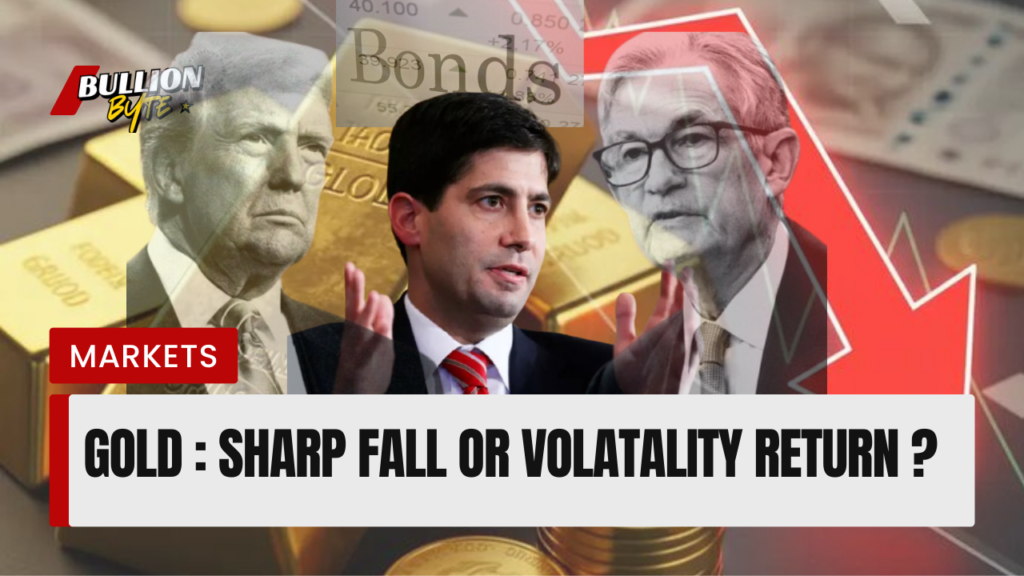
Gold shocked global markets at the end of January 2026. Prices fell nearly 12% in a single day, marking the biggest one-day drop in 13 years. Many investors immediately asked the same question:
👉 Is this the end of the gold bull market?
According to UBS Chief Investment Office (CIO), the answer is no. History suggests this is more likely a mid-cycle correction, not a long-term trend reversal.
🔍 What Caused Gold to Fall So Sharply?
The sudden sell-off happened after US President Donald Trump nominated Kevin Warsh as the next Federal Reserve Chair.
Markets reacted because Warsh is seen as:
- 🦅 More hawkish on inflation
- 📉 Less supportive of large balance sheets
- 🏦 Focused on tightening financial discipline
This led to:
- 💵 A stronger US dollar
- 📈 Fear of higher real interest rates
- ⚠️ Margin calls and forced selling in gold futures
Such sharp drops often look scary — but history shows they are not unusual during strong gold bull markets.
💰 Current Gold Price Levels (As per UBS)
UBS clearly outlines where gold may move next:
- 📍 Spot price (30 Jan 2026): ~$4,894/oz
- 🔄 Near-term range: $4,500 – $4,800/oz
- 🚀 Mid-2026 target: $6,200/oz
- 🧾 End-2026 forecast: ~$5,900/oz
UBS expects gold to consolidate first, then resume its upward trend once volatility cools.
🧠 Why UBS Believes the Gold Bull Market Is Still Alive
1️⃣ Gold bull markets don’t end easily
Historically, gold bull markets ended only when:
- Real interest rates stayed high for a long time
- The US dollar became structurally strong
- Inflation fears disappeared
- Investors fully trusted central banks again
UBS argues that none of these conditions exist today.
2️⃣ Interest rates are still expected to fall
Despite short-term fear, markets are still pricing:
- 🔽 Around two US rate cuts
- 📉 About 53 basis points of easing by end-2026
- 🛑 Quantitative tightening officially ended in December 2025
Historically, falling real rates support higher gold prices.
3️⃣ Strong demand for physical gold
UBS recently raised gold demand forecasts because of:
- 🏛️ Heavy central bank buying
- 📊 Rising ETF inflows
- 🪙 Strong bar and coin demand
- 🌍 Ongoing geopolitical uncertainty
These are classic drivers seen in past gold rallies.
🕰️ What History Tells Us About Similar Corrections
🔴 When gold bull markets really ended
- 1980 (Volcker era):
Extremely high interest rates crushed inflation and restored faith in the dollar. - 2013 (Taper Tantrum):
The Fed proved it could exit stimulus without causing chaos.
In both cases, confidence in central banks returned — and gold fell for years.
🟡 Mid-cycle corrections that looked scary (but weren’t)
- 1974: Gold fell sharply, then surged to new highs by 1980
- 2020: Gold corrected after COVID panic eased, then resumed its rally later
UBS believes 2026 looks more like these periods, not a final top.
📊 Technical Analysis (Simplified)
From a technical perspective, gold’s recent fall does not break the long-term bullish structure.
Key technical observations:
- 🧱 Current Market Price (CMP): $4,775 | ₹1,49,000
- 🔁 Support Levels :
• $4,600 | ₹1,45,000
• $4,400 | ₹1,38,000
• $4,350 | ₹1,36,000
• $4,000 | ₹1,22,000 - 📉 Resistance Levels :
• $4,850 | ₹1,52,000
• $5,000 | ₹1,58,000
• $5,350 | ₹1,72,000 - 📈 Expected Monthly Range :
• $4,350 – $5,350
• ₹1,36,000 – ₹1,72,000
🧭 Where Are We Now in the Gold Cycle?
UBS places gold in a mid-to-late stage bull market, characterized by:
- 📊 Higher highs
- 🔄 Frequent 5–8% pullbacks
- ⚡ Rising volatility
- 🧹 Shaking out short-term traders
This is normal behavior before major upside moves, not after them.
🧾 What Should Investors Do?
UBS views gold as:
- 🛡️ A long-term hedge, not a short-term trade
- ⚖️ A portfolio stabilizer due to low correlation with equities
Key takeaway:
Volatility may continue, but the broader trend remains intact unless real rates rise sharply and central bank credibility is fully restored — which UBS does not expect.
🧭 Conclusion
📌 Gold did not fall because the story ended — it fell because volatility returned.
Both history and technical structure suggest that this move is a mid-cycle shakeout, not the end of the bull market. Until real interest rates stay high and faith in central banks is fully restored, gold continues to act as a strategic hedge in uncertain times.
📚 References
- UBS Chief Investment Office (CIO), “Not the End – Gold”, February 2026
- UBS Global Wealth Management Research
- Bloomberg (price data referenced by UBS)
- World Gold Council (gold demand trends, as cited by UBS)
⚠️ Risk Disclaimer
This article is for educational and informational purposes only and does not constitute investment advice, a recommendation, or an offer to buy or sell any financial instrument. Gold and other commodities are subject to significant price volatility. Past performance is not indicative of future results. Investors should consider their financial situation, risk tolerance, and consult with a qualified financial advisor before making any investment decisions.